We will continue with our Seminar Series on October 2nd, 2023
On site: Salón de Grados Leganés
For the next event in the Aerospace PhD Seminar Series, we will have the pleasure of hosting Dr. Miguel Pérez Encinar, a visiting professor at Universidad Carlos III de Madrid.
The event will take place in the Salón de Grados on Monday, October 2nd at 1pm and will be streamed (Online).

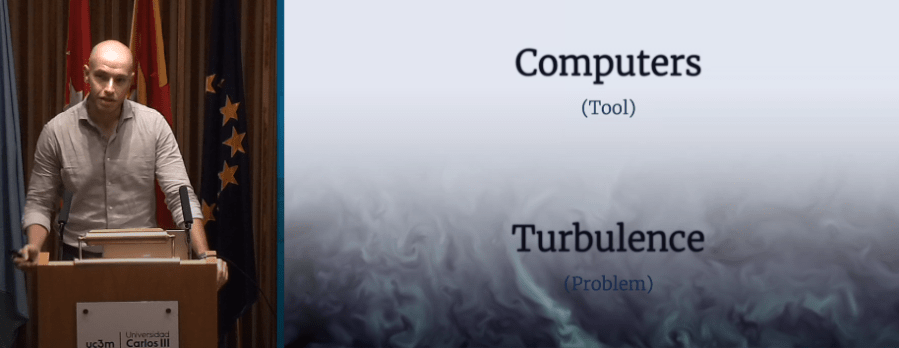
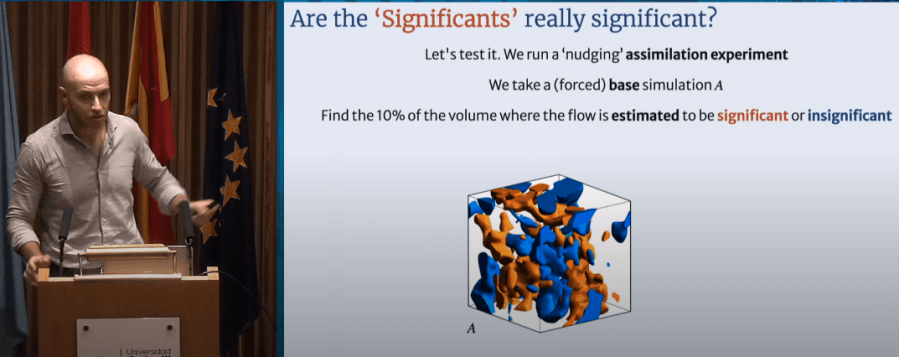

Miguel P. Encinar is a PhD holder in Aerospace Engineering, having earned his degree in 2020 under the guidance of Prof. J. Jiménez. He has also served as a postdoctoral researcher in the Department of Mechanical Engineering at Johns Hopkins University. Currently, he holds the position of Visiting Professor at UC3M. His research primarily centers on turbulent flows, and he has authored publications that delve into the analysis of turbulence in both wall-bounded and open flows. His research methodology revolves around conducting direct numerical simulations of the Navier-Stokes equations, leveraging cutting-edge High-Performance Computing (HPC) architectures, including GPUs. These simulations span a wide spectrum, ranging from some of the largest available simulations of turbulent flow to extensive ensembles of smaller simulations. This unique approach allows for the novel analysis of turbulent flows.
“Can new computing architectures help disentangle turbulence?”
Abstract:
Turbulence is among the few open problems of classical mechanics, and one of monumental importance for both fundamental physics and engineering problems. It is the archetypical example of a dynamical system with enormous complexity, and thus, simply analysing its properties is a challenging task. Since the advent of numerical simulations in the late 70s, computers have aided researchers in tackling this complexity by providing high-quality data that enables the development of better models, for predicting, calculating or controling turbulent flows.
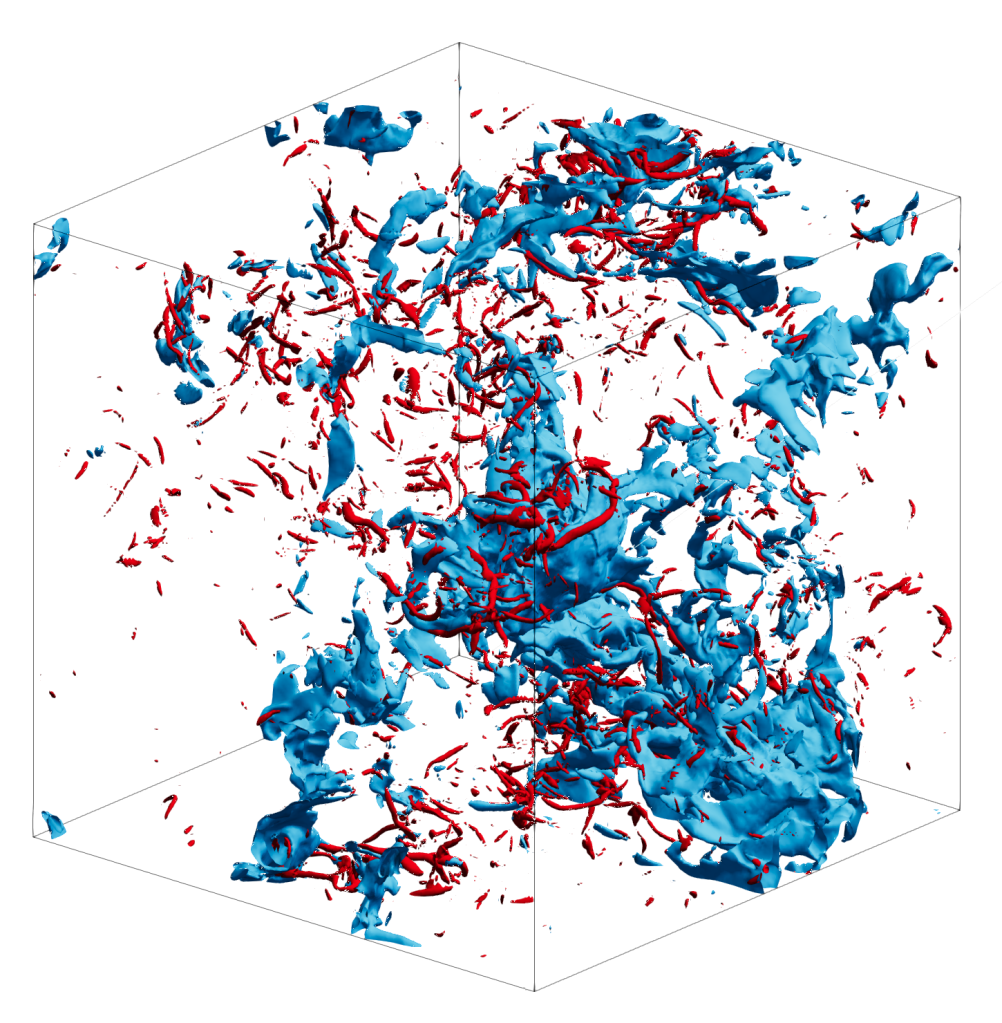
In this seminar, we explore how emergent computing architectures (GPUs) can be exploited to facilitate research of complex problems with the aid of simulations. We will use a few examples, ranging from very large simulations of wall-bounded turbulent flows to massive ensembles of small(er) simulations of isotropic turbulence. We analyse how this data can be used to provide new insights in the problem of turbulence, and we emphasize that these methodologies can be applied to other complex problems in physics and engineering.
The seminars will begin at 1pm and will take place in the Auditorium Salón de Grados (Padre Soler)
No previous registration is required.
 PhD in Aerospace Engineering UC3M