We will continue with our Seminar Series on January 16th, 2024
On site: Salón de Grados Leganés
For the next event in the Aerospace PhD Seminar Series, we will have the pleasure of hosting Dr. María Cerezo, a visiting professor at UC3M.
The event will take place in the Salón de Grados on Tuesday, January 16th at 1pm and will be streamed (Online).
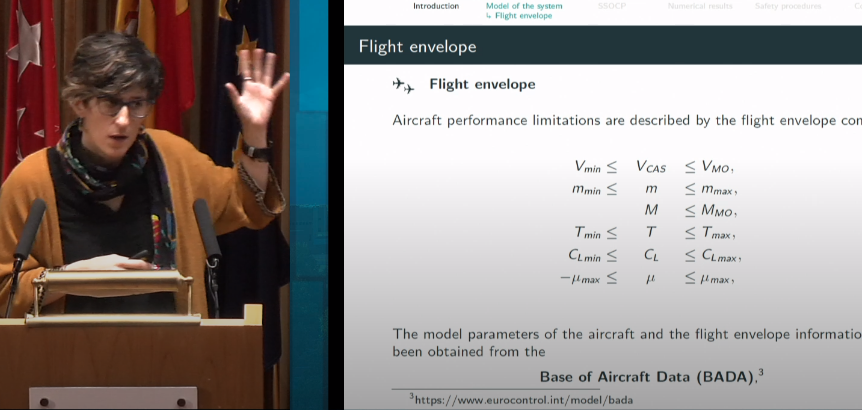
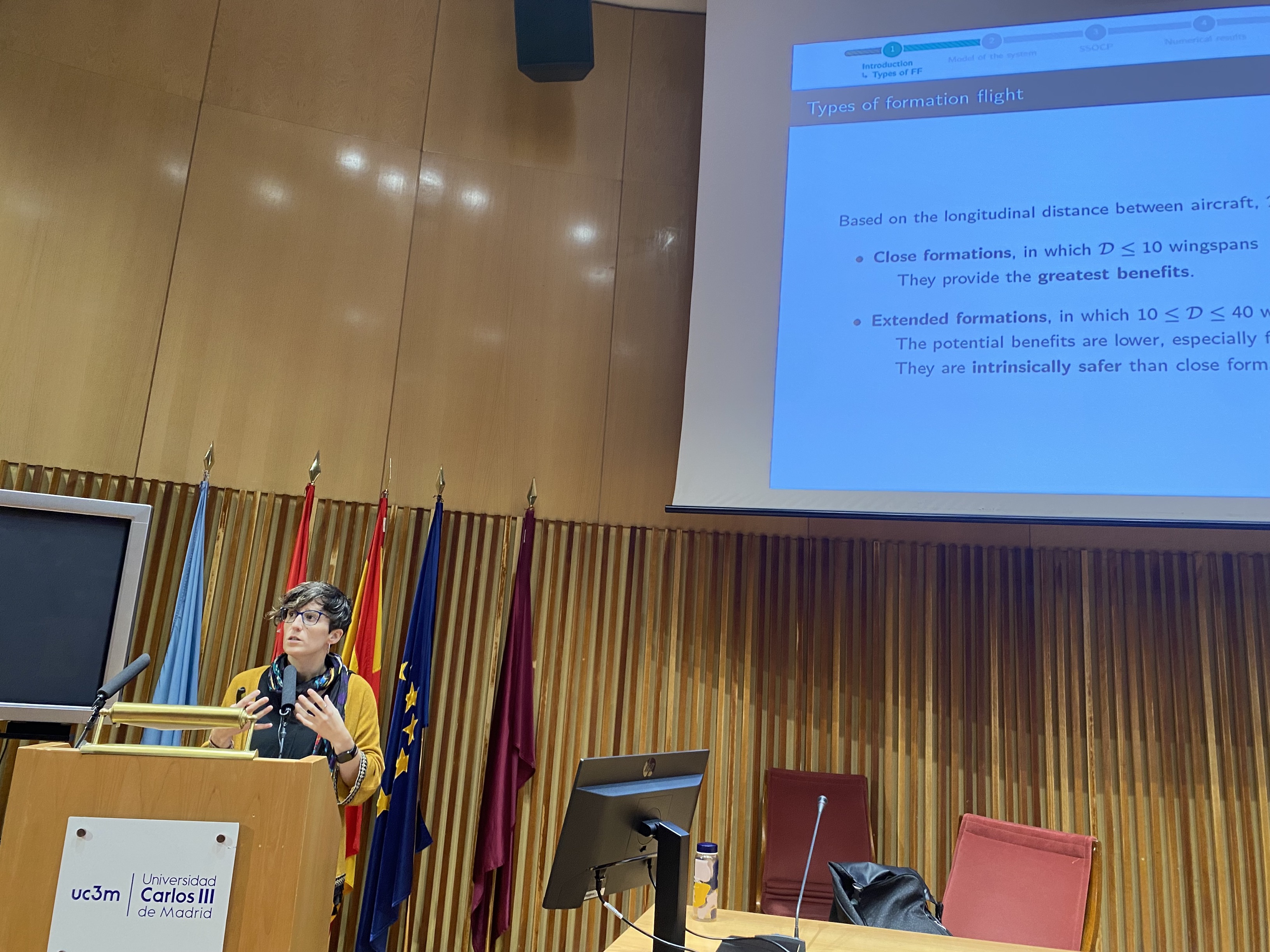
María Cerezo received her Aerospace Engineering PhD from the Universidad Rey Juan Carlos (URJC). She is currently Visiting Professor at Universidad Carlos III of Madrid (UC3M) within the Aerospace Engineering Department. Her main research is focused on deterministic and stochastic optimal control applied to trajectory optimization in Air Traffic Management (ATM), in particular, with strategies to mitigate global climate change applications such as commercial formation flight. She has been granted a scholarship to do a research stay at the Faculty of Aerospace Engineering at the Delft University of Technology, Netherlands, where she continued developing her research. María Cerezo has been recognized with the Three Minute Thesis (3MT) Award, of the Community of Madrid, in the field of Engineering and Architecture. She has also been honoured with Extraordinary Doctorate Award by URJC.
“Exploring the possibilities of commercial formation flight using a stochastic optimal control approach”
Abstract:
Currently, the main challenge for global aviation is to ensure that the predicted growth in air traffic for the coming decades remains sustainable from an environmental point of view, and that the air traffic management system meets the expected demand for increased capacity. Formation flight offers great promise in terms of improving both the environmental impact of aviation and the capacity of the air traffic management system.
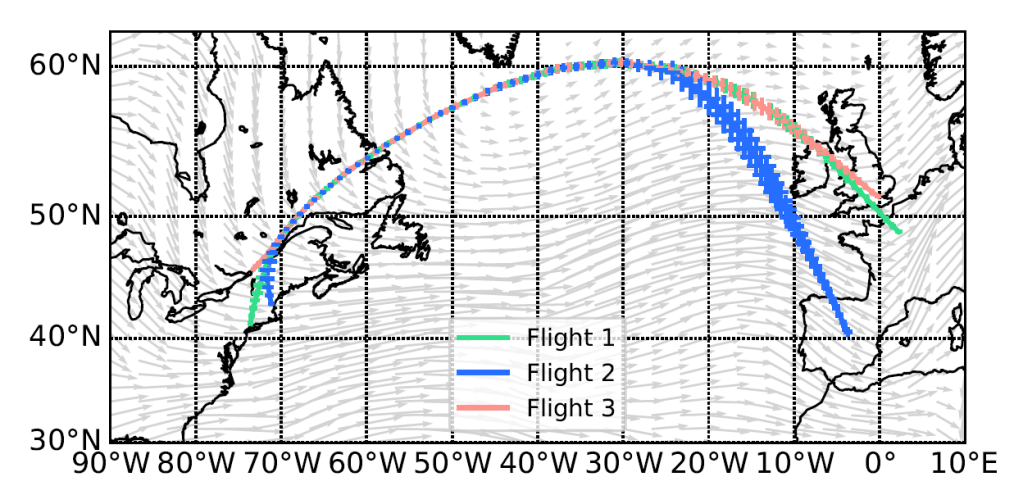
In this seminar, we address the formation mission design problem for commercial aircraft in the presence of uncertainties. Specifically, it considers uncertainties in aircraft departure times and in the fuel burn savings for the trailing aircraft. Given several commercial flights, the problem consists in arranging them in formation or as solo flights and finding the trajectories that will minimize the expected value of the direct operating cost of the flights. Since each aircraft can fly solo or in different positions inside a formation, the mission is modeled as a stochastic switched dynamical system, in which aircraft flight modes are described by sets of stochastic ordinary differential equations, the discrete states of the system describe the combination of flight modes of the individual aircraft, and the switching logic among the discrete states is defined by logical constraints. Also, chance constraints have been included.
The obtained results demonstrate that benefits can be achieved even in the presence of typical air traffic uncertainties and that formation flight has great potential to reduce fuel consumption and emissions in commercial aviation.
The seminars will begin at 1pm and will take place in the Auditorium Salón de Grados (Padre Soler)
No previous registration is required.
 PhD in Aerospace Engineering UC3M