We continue our seminars serie, on Tuesday, Feb. 25th at 13.00
On site: Salón de Grados (Leganés)
For this event in the Aerospace PhD Seminar Series, we had the pleasure of hosting Dr. Rodrigo Castellanos García De Blas, Assistant Professor at UC3M.
The event was streamed (Online) on Tuesday, February 25th.
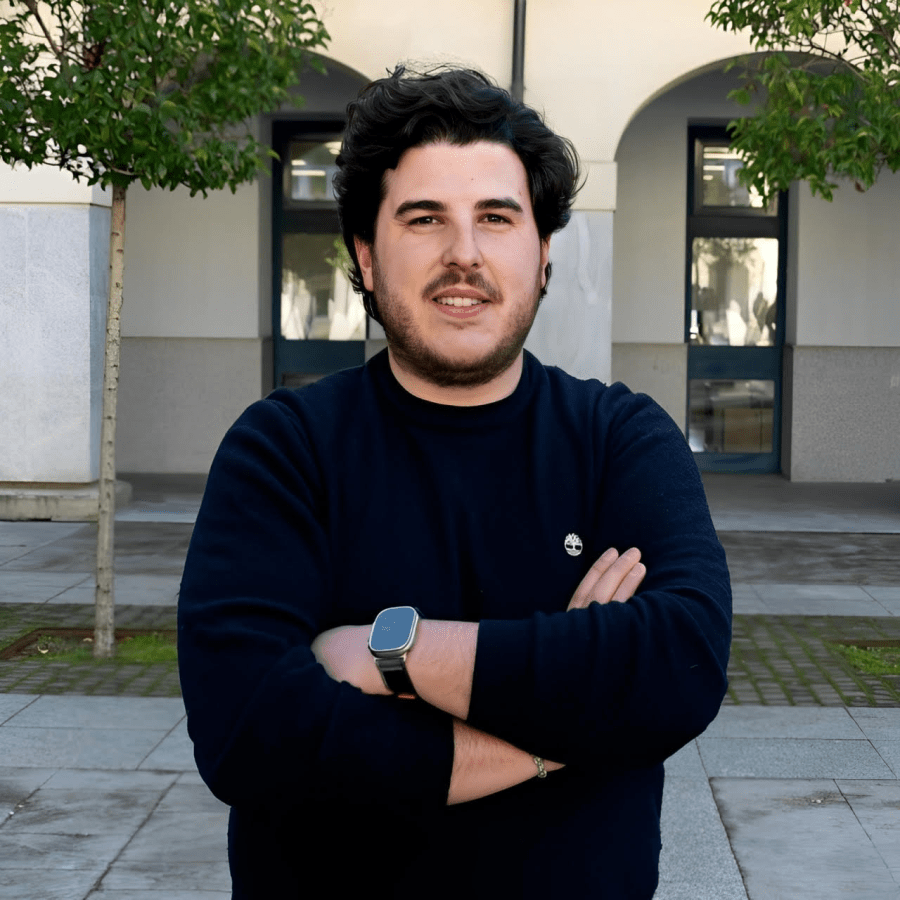
Rodrigo Castellanos earned his PhD in Fluid Mechanics from Universidad Carlos III de Madrid (UC3M) in December 2022, specializing in flow control and convective heat transfer enhancement. He later joined the National Institute for Aerospace Technology (INTA) as a researcher, working on high-fidelity aerodynamic modelling and optimization using machine learning and data-driven methods. Since 2024, he has been an Assistant Professor at UC3M, where he is developing a research line on AI-driven surrogate modelling for aeronautics. His work focuses on data-driven models, multifidelity approaches, and model-free optimization for aerodynamic and aircraft design. He is actively involved in national and European research projects and co-supervises four PhD theses in collaboration with INTA, promoting an interdisciplinary research group.
“Making Aerodynamics Great Again (But Smaller): Low-Dimensional, Data-Efficient Surrogates“
Abstract:
The increasing computational cost of high-fidelity Computational Fluid Dynamics simulations has led to a growing need for efficient surrogate modelling techniques in aerodynamics. This seminar explores the integration of manifold learning and neural networks to construct high-accuracy surrogate models that capture the underlying structure of aerodynamic data while significantly reducing computational requirements.
We begin by addressing dimensionality reduction as a key enabler of surrogate modelling. Isometric Feature Mapping (Isomap) and β-variational autoencoders (β-VAE) are employed to uncover a latent space where aerodynamic flow fields exhibit smooth variations, enabling efficient interpolation. By mapping high-dimensional aerodynamic fields onto this manifold and applying Gaussian Process Regression or neural network-based interpolation, we reconstruct aerodynamic quantities with minimal information loss, providing fast and reliable predictions.
Additionally, we discuss how multi-fidelity modelling can further enhance surrogate performance. By combining low- and high-fidelity data using multi-fidelity Gaussian Process Regression (MF-GPR) and Gappy POD, we demonstrate how surrogate models can increase accuracy while reducing the amount of high-fidelity data required.
Join the seminar to explore ideas on how data-driven surrogate modelling and multi-fidelity strategies are reshaping the way we approach aerodynamic predictions, making high-fidelity insights more accessible and computationally feasible.

The seminar began at 13:00.
No previous registration was required.
 PhD in Aerospace Engineering UC3M