We continue our seminars serie, on Tuesday, October 28th at 13:00H
On site: Salón de Grados
For this event in the Aerospace PhD Seminar Series, we had the pleasure of hosting Dr. Ahilan Appar, Professor at UC3M.
The event took place in the Salón de Grados on Tuesday, October 28th at 13:00 pm and was streamed online.
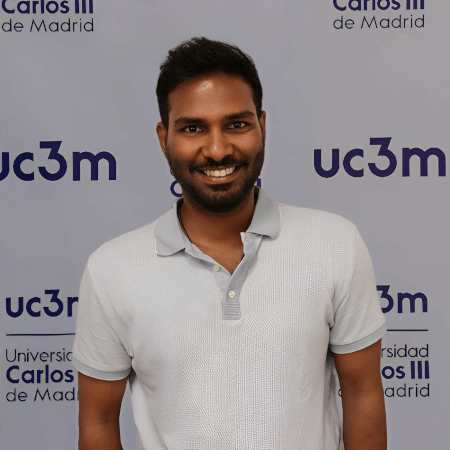
Ahilan Appar is a Professor at Universidad Carlos III de Madrid (UC3M). Before that, he received his PhD (2023) and MTech (2017) in Aerospace Engineering from the Indian Institute of Technology Kanpur, and his B.E. (2014) in Aeronautical Engineering from the Madras Institute of Technology, Chennai. His research focuses on hypersonic and rarefied gas dynamics, with an emphasis on developing multiscale and multiphysics models for high-speed flows. He integrates molecular dynamics (MD) and direct simulation Monte Carlo (DSMC) methods to study gas–surface interactions and flow behaviour relevant to hypersonic vehicles and spacecraft operating in very low Earth orbit (VLEO). Previously, he developed computational frameworks for aerothermodynamic analysis of re-entry vehicles, addressing material response modelling, ablation phenomena, and transpiration cooling effects. His work also established flow–thermal stability criteria for strongly coupled ablation problems in hypersonic systems. His broader research interests include re-entry aerothermodynamics, gas–surface interaction modelling, and rarefied flow physics.
“Multiscale and Multiphysics Modeling: From Gas–Surface Interactions in VLEO to Hypersonic Reentry Flows“
Abstract:
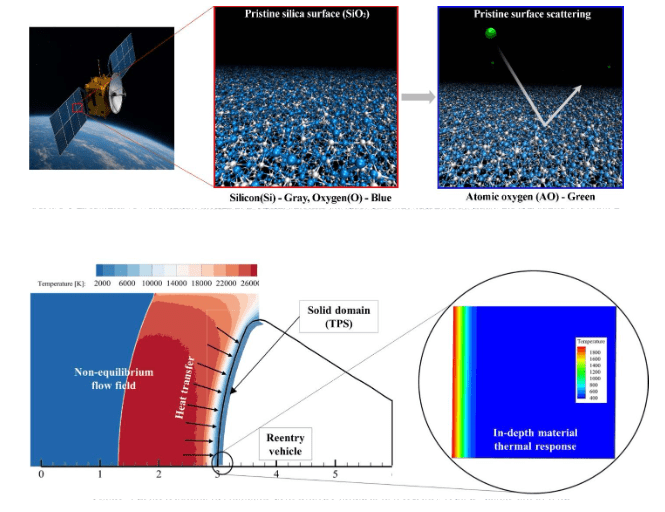
This seminar provides an overview of research activities on multiscale and multiphysics modelling of gas–surface interactions (GSI) across distinct flight regimes, ranging from very low Earth orbit (VLEO) satellites to hypersonic re-entry vehicles. The objective is to establish physically consistent models that bridge molecular-level phenomena with continuum-scale flow behaviour, thereby enhancing the predictive capability of aerospace systems.
The first part of the seminar focuses on the ongoing research on GSI modelling for spacecraft in VLEO. In this altitude regime, accurate drag estimation is critical for orbit prediction, control, and collision avoidance, and strongly depends on hyperthermal interactions between atomic oxygen (AO) and spacecraft surfaces. Using reactive molecular dynamics (MD) simulations, the scattering of AO from amorphous silica, a representative material for satellite coatings, has been investigated. The results show excellent agreement with molecular beam experiments, accurately capturing angular distributions and energy accommodation characteristics. Building on these insights, a new hybrid model, termed the diffuse–Cercignani–Lampis–Lord (DCLL) model, has been developed. The DCLL model combines non-drifting diffuse Maxwellian and impulsively scattering drifting velocity distributions, reproducing both MD and experimental observations while maintaining a structure suitable for particle-based solvers like direct simulation Monte Carlo (DSMC) and test particle Monte Carlo (TPMC) solvers. This new model provides a robust and computationally efficient framework for predicting drag and analysing the orbital dynamics of VLEO spacecraft and can be extended to particle-in-cell (PIC) solvers to study plasma surface interaction problems.
The second part addresses the past research on conjugate heat transfer (CHT) analysis for hypersonic re-entry vehicles under semi-rarefied conditions. A modified, mass-injecting DSMC framework was coupled with a material thermal response (MTR) solver to study flow–thermal coupling and ablation-induced numerical instabilities between 120 and 90 km altitudes. The findings highlighted the influence of high-altitude heat flux history on low-altitude flow–thermal behaviour. Also, it revealed limitations in existing flow-surface boundary models and emphasised the need for new sophisticated boundary models.
Collectively, these efforts advance predictive modelling of gas–surface phenomena across high-speed flight regimes, contributing to improved understanding and design of next-generation aerospace systems.
The seminar began at 13:00 pm and took place in the Salón de Grados.
No previous registration was required.
 PhD in Aerospace Engineering UC3M