We continue our seminars serie, on Tuesday, January 27th at 13:00H
On site: Salón de Grados
For this event in the Aerospace PhD Seminar Series, had the pleasure of hosting Dr. Alberto Marín Cebrián, Assistant Professor in the Aerospace Engineering Department at UC3M.
The event took place in the Salón de Grados on Tuesday, January 27th at 13:00 H and was streamed online.
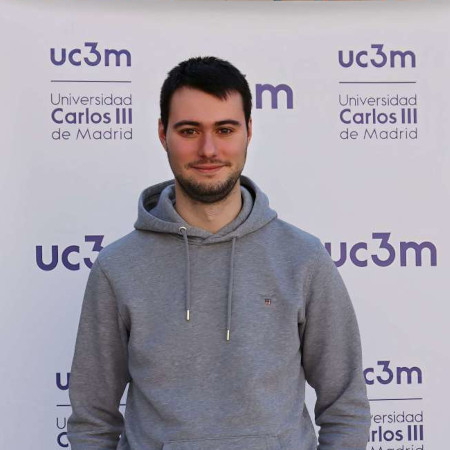
Alberto Marín Cebrián is an Assistant Professor of Aerospace Engineering at Universidad Carlos III de Madrid (UC3M). He received a Bachelor’s degree in Aerospace Engineering, a Master’s degree in Aeronautical Engineering, and a Ph.D. in Aerospace Engineering from UC3M in 2018, 2020, and 2024, respectively. He conducted a research stay at the Princeton Plasma Physics Laboratory in 2023. After completing his Ph.D., he remained at UC3M as a postdoctoral researcher until obtaining his current position in July 2025. His main research focus is the investigation of the kinetic electron response in Hall effect thrusters. He is also interested in anomalous transport, plasma plumes, and plasma-wall interactions in tokamaks. His research approach relies on numerical simulations using a particle-in-cell (PIC) formulation, and he is one of the main developers of the 2D PIC code PICASO.
“Open problems in Hall effect thruster physics: insights from a kinetic model“
Abstract:
Nowadays, electric propulsion is the most commonly employed system for in-space operations. It offers a higher specific impulse than traditional chemical propulsion, thereby enabling significant reductions in mass and costs for space missions. Among the different electric thruster designs, Hall effect thruster (HET) is currently the leading technology for most commercial applications. However, the plasma discharge physics are very complex and not yet fully understood. The two main open problems in HET research are plasma-wall interaction and anomalous transport. Plasma-wall interaction is responsible for energy losses and erosion, while anomalous transport degrades the axial confinement of electrons; both of them affect the performance and lifetime of these devices.
The low collisionality in the HET discharge prevents the plasma from reaching local thermodynamic equilibrium. As a consequence, the classical drift-diffusive fluid formulation for electrons can misrepresent important phenomena. Alternatively, kinetic models are more suitable, as they resolve the velocity distribution function (VDF) of the different species. Among kinetic approaches, those based on a particle-in-cell (PIC) formulation are currently more computationally affordable than direct Boltzmann solvers. Consequently, a two dimensional PIC code (PICASO) has been developed to study the HET plasma.
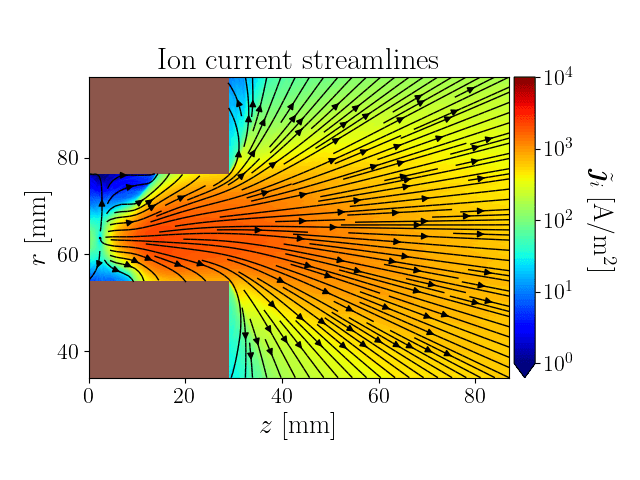
Axisymmetric axial-radial simulations are run to analyze the kinetic electron response in the HET channel. Three different scenarios, of increasing complexity, are considered: (1) a simplified case with a purely radial magnetic field, (2) a HET with a conventional magnetic topology and (3) a modern magnetically shielded HET. The simulation results show that the electron VDF departs from Maxwellian, with a strong dependence on the magnetic field topology and distinct behavior at different locations within the thruster channel. As a consequence, the macroscopic electron response differs from a collisional fluid. In particular, the wall interaction parameters deviate significantly from classical theory, the heat flux does not follow a Fourier-type law and finite Larmor radius effects (including inertia and gyroviscosity) are found to be relevant in the azimuthal electron momentum equation.
Axial-azimuthal scenarios are simulated to analyze anomalous transport. This phenomenon has been mainly attributed to azimuthal plasma oscillations, and it has been postulated that its main primary contributor is the electron cyclotron drift instability (ECDI). Current research seeks to elucidate the effect of the ECDI on the cross-field electron current.
The seminar began at 13:00 pm and took place in the Salón de Grados.
No previous registration was required.
 PhD in Aerospace Engineering UC3M