We continue our seminars serie, on Tuesday, March 17th, 13:00 H.
On site: Sala de vídeo 3.S1.08 Biblioteca
For this event in the Aerospace PhD Seminar Series, we will have the pleasure of hosting Dr. Onofrio Semeraro, Research Associate at the Laboratoire Interdisciplinaire des Sciences du Numérique (LISN) at Centre national de la recherche scientifique (CNRS) (París, France).
The event will take place in the Sala de vídeo 3.S1.08 Biblioteca on Tuesday, March 17th, at 13:00 H and it will be streamed online.

Dr. Onofrio Semeraro received his PhD in Mechanical Engineering at KTH-Stockholm (Sweden) in 2013. He served as postdoctoral researcher at Ecole-Polytechnique, Palaiseau (France) and Politecnico of Bari (Italy), and he is currently a CNRS Research Associate since 2017, at the Laboratoire Interdisciplinaire des Sciences du Numérique (LISN) – Universite Paris Saclay, Orsay (France). His studies focus mainly on control, data assimilation, modelling and data-driven techniques, ranging from system identification to deep learning for fluid mechanics. He is currently PI of an ANR project dedicated to optimal control and Reinforcement Learning for control of fluids, and contributors for projects at the intersection of machine learning, dynamical systems and fluid dynamics.
“Reliability of data-driven strategies: case studies in fluid mechanics”
Abstract:
Machine learning is rapidly transforming scientific computing; nonetheless, its apparent simplicity often conceals important limitations, including limited generalizability, weak guarantees, and strong case dependence. Simply increasing dataset size or model complexity does not automatically resolve these issues and can introduce significant computational costs. When feasible, incorporating physical constraints can improve robustness and interpretability.
This talk presents several recent case studies from our group, with an emphasis on reliability and performance guarantees.
First, we examine modeling and prediction with neural networks, focusing on Long Short-Term Memory (LSTM) architectures. We investigate how the structure of the training data and the dynamics of memory gates influence long-term predictive behavior. Drawing on ideas from ergodic theory and curriculum learning, we analyze how dataset design can promote stable and faithful modeling, while also enabling principled active learning strategies.
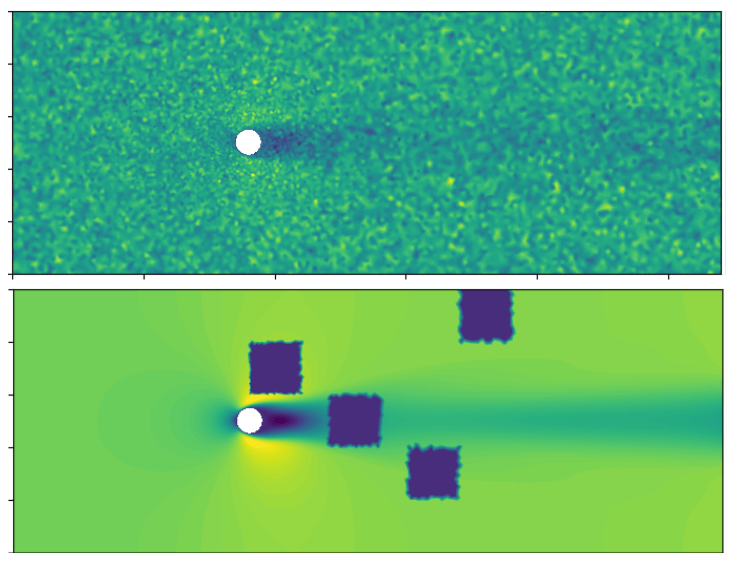
In the second example, we explore Graph Neural Networks (GNNs) for data assimilation, using the Reynolds–Averaged Navier–Stokes (RANS) equations as a baseline model. GNNs are particularly well suited for representing complex, multiconnected systems, making them attractive for unstructured meshes in computational fluid mechanics. We introduce a supervised-learning closure model for the RANS equations and combine it with direct-adjoint methods and active learning. Our results provide insight into how effectively GNN-based closures can be parameterized and where their limitations arise.
Finally, we turn to flow control, where Reinforcement Learning (RL) is increasingly explored as an alternative to traditional model-reduction approaches. RL does not require explicit knowledge of the governing equations and instead learns control policies directly from flow measurements. However, early applications often produce nonintuitive or overly complex policies, even when simpler strategies exist. As a final case study, we present a policy iteration strategy tailored to convective flows, designed to improve convergence and policy interpretability.
The seminar will begin at 13:00 pm and will take place in the Sala de vídeo 3.S1.08 Biblioteca.
No previous registration will be required.
 PhD in Aerospace Engineering UC3M