Dr. Miguel A. Mendez
The von Karman Institute for Fluid Dynamics (VKI)
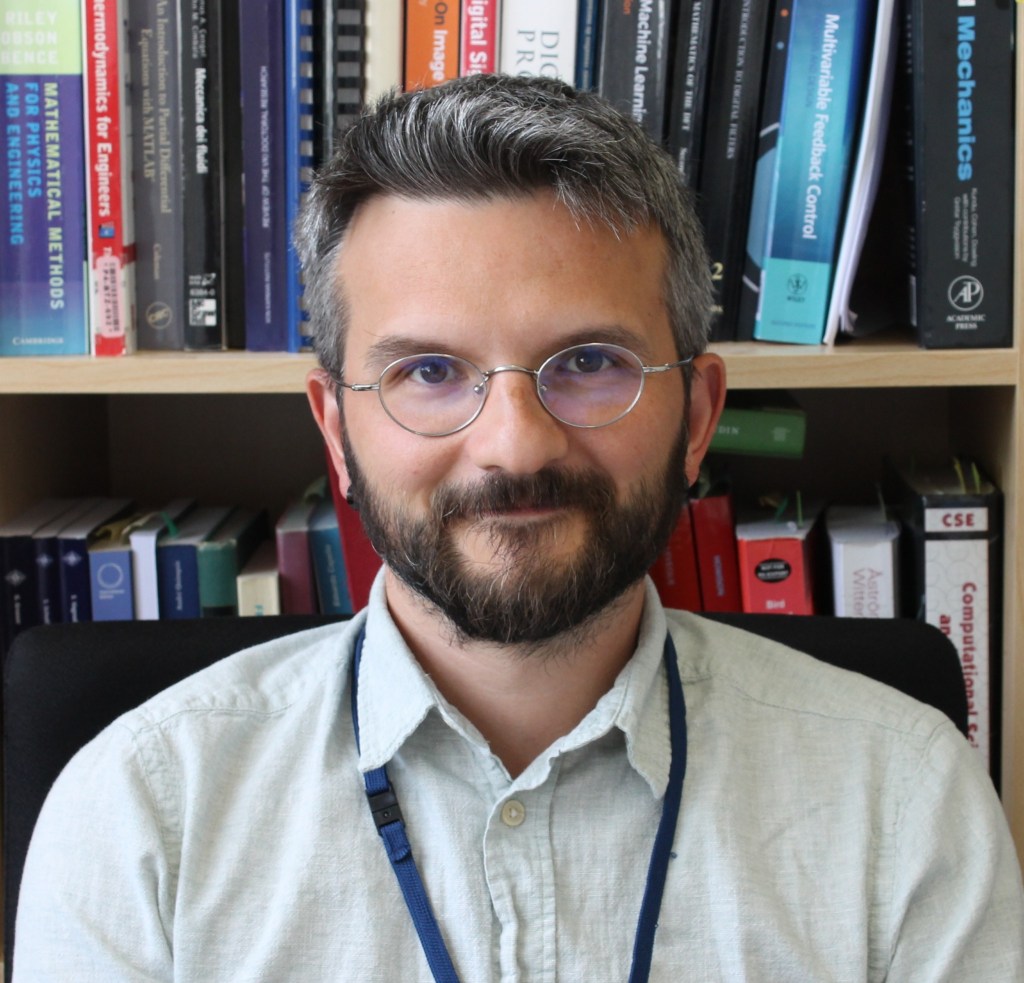
Miguel A. Mendez received his Ph.D. in Engineering Science from the Université Libre de Bruxelles (ULB) in 2018. He is an Associate Professor at the von Karman Institute for Fluid Dynamics (VKI), where he teaches fluid flow modeling, measurement techniques, and machine learning for fluid dynamics. His research focuses on coating flows, experimental fluid mechanics, reduced-order modeling, and flow control in low-speed aerodynamics and cryogenic storage. In 2021, he developed and launched the VKI lecture series “Hands-On Machine Learning for Fluid Dynamics.” Recently, he was awarded an ERC Starting Grant for the project “RE-TWIST,” which combines reinforcement learning and model-based control with real-time data assimilation and digital twinning.
From Optimal Control to Learning-Based Control: A Unified Perspective on Adaptive Control and Reinforcement Learning
Modern engineering systems increasingly operate in conditions where accurate first-principles models are incomplete, uncertain, or evolve over time. In this context, control strategies must progressively transition from purely model-based formulations toward adaptive and learning-based approaches capable of improving performance directly from data.
This mini-course introduces the fundamental connections between optimal control, adaptive control, variational optimization, Bayesian optimization and reinforcement learning. Starting from classical optimal control formulations and adjoint-based optimization, the course progressively moves toward data-driven and model-free paradigms, highlighting both their differences and their deep conceptual links.
Particular emphasis is placed on the interpretation of learning algorithms from a control-theoretic perspective. Topics include variational formulations of adaptive control, policy search methods, Gaussian-process-based Bayesian optimization, and introductory value-based reinforcement learning through Q-learning. Throughout the course, the methods are illustrated on simplified dynamical systems and control problems relevant to fluid mechanics, aerospace engineering and real-time modelling.
The course is structured in four modules:
- Module 1: Introduction to Optimal Control Theory.
- Module 2: Generalized Adaptive and Dual Control Problems.
- Module 3: Model-Free Control and Bayesian Policy Search.
- Module 4: An Introduction to Reinforcement Learning and Q-Learning.
Key Details About the Course:
- Dates: June 1st, 2026, 10:00H – 14:00H.
- Location: Aula 1.0C.01, Agustín de Betancourt building, Leganés campus.
The event will be in presence and previous registration is required.

