We continue our seminars serie, on Thursday, April 23rd, at 13:00 H.
On site: Salón de Grados
For this event in the Aerospace PhD Seminar Series, we had the pleasure of hosting Dr. Serhiy Yarusevych, full professor in the Department of Mechanical and Mechatronics Engineering at the University of Waterloo, Canada.
The event took place in the Salón de Grados on Thursday, April 23rd, at 13:00 H and was online.
Dr. Serhiy Yarusevych is a full professor in the Department of Mechanical and Mechatronics Engineering at the University of Waterloo, Canada. He is directing the Fluid Mechanics Research Laboratory focused on multidisciplinary applications of fluid mechanics in engineering, including operation of lifting surfaces at low Reynolds numbers, flows over bluff bodies, free shear flows, flow induced vibrations and noise, and flow control. The associated research involves a combination of experimental, analytical, and numerical tools, with the main emphasis placed on experiments involving particle image velocimetry. His research in Canada was interposed by sabbatical leaves at TU Delft in the Netherlands (2013-2014; 2025-2026) and the University of Bundeswehr Munich in Germany (2019-2020), focusing on collaborative projects in aerodynamics and flow control. Dr. Yarusevych is an Alexander von Humboldt Fellow, Mercator Fellow, and Associate Fellow of AIAA. Since 2018, Dr. Yarusevych has been serving as an Editor-in-Chief of Experimental Thermal and Fluid Science, Elsevier.
“Flows over Lifting Surfaces at Aerodynamically Low Reynolds Numbers”
Abstract:
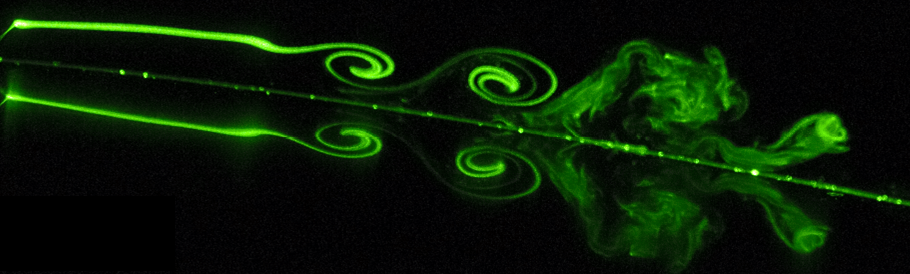
Flow development over lifting surfaces operating at aerodynamically low Reynolds numbers (Re<500,000) is largely governed by boundary layer separation and subsequent separated sear layer development on the suction side. In the time-averaged sense, rapid laminar-to-turbulent transition in the separated shear layer leads to the formation of a closed recirculating flow region referred to as the Laminar Separation Bubble (LSB). However, LSBs feature rich dynamics associated with the formation and evolution of shear layer roll up vortices leading to laminar-to-turbulent transition. Linear stability analysis confirms that there is a continuous stability spectrum spanning laminar boundary layer and separated shear layer regions, linking LSB transition and shear layer vortex shedding to the upstream amplification of disturbances that originate from free-stream perturbations in the receptivity region. Flow development in the aft portion of the bubble is highly three-dimensional even on nominally two-dimensional geometries. It manifests in progressive deformation of shear layer vortices and subsequent vortex breakdown. On a finite wing, an open LSB forms due to wing tip and root effects. Away from the affected regions, however, LSB topology and dynamics appear to be quasi two-dimensional despite effective angle of attack variation across the span. Changes in operating conditions, including velocity and angle of attack, can lead to significant transient flow developments associated with bubble bursting (i.e., sudden lengthening or full separation without subsequent reattachment) and LSB re-formation, accompanied by substantial changes in aerodynamic loads.
The seminar began at 13:00 pm and took place in the Salón de Grados.
No previous registration was required.

