We continue our seminars serie, on Friday, May 29th, 12:00 H.
On site: Sala de video 3.S1.08
For this event in the Aerospace PhD Seminar Series, we had the pleasure of hosting Dr. Pablo Machuca, Assistant Professor in the Department of Aerospace Engineering at San Diego State University, California, United States of America.
The event took place in the Sala de video 3.S1.08 on Friday, May 29th, at 12:00 H and it was streamed online.
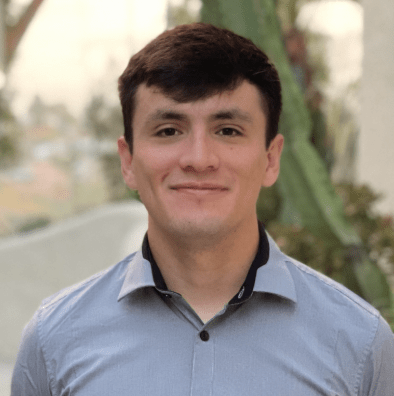
Dr. Pablo Machuca is currently an Assistant Professor in the Department of Aerospace Engineering at San Diego State University. Pablo completed his Ph.D. on “Mission Design for Asteroid Exploration Using Autonomous CubeSats” at Cranfield University (United Kingdom) in 2021. He then joined University of California San Diego as a postdoctoral researcher on “Cislunar Space Domain Awareness” in 2021, and completed a second postdoc at Massachusetts Institute of Technology on “Space Debris Modeling and Propagation” in 2022. Pablo’s research interests include astrodynamics in dynamically complex environments and autonomous guidance, navigation and control, with applications to deep-space exploration, and small-spacecraft mission analysis and systems design.
“Lost in Space: How to Navigate around the Moon and Beyond?”
Seminar – Pablo Machuca – Lost in Space: How to Navigate around the Moon and Beyond?
Abstract:
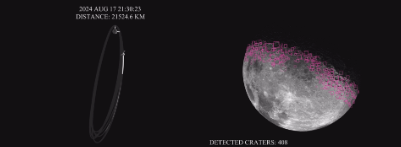
This seminar will cover on-going research efforts on autonomous optical navigation for deep- space missions. Applications of interest include trajectories beyond Geostationary Earth Orbit, lunar transfers, lunar orbits, and missions to asteroids or comets. We explore the potential of techniques such as edge detection, centroiding, neural network-based feature detection (for lunar crater and Earth coastline detection), pattern recognition, etc. An overview of our simulation framework is provided, including image generation, image processing, characterization and modeling of measurement errors, filtering, uncertainty quantification, and validation through hardware-in-the-loop experiments. Autonomous optical navigation can enable lower cost, more flexible, independent, resilient, and sustainable space exploration, and its promise, technical challenges, expected performance, and limitations are discussed in this talk.
The seminar began at 12:00 pm and took place in the Sala de video 3.S1.08 de la Biblioteca.
No previous registration was required.

